
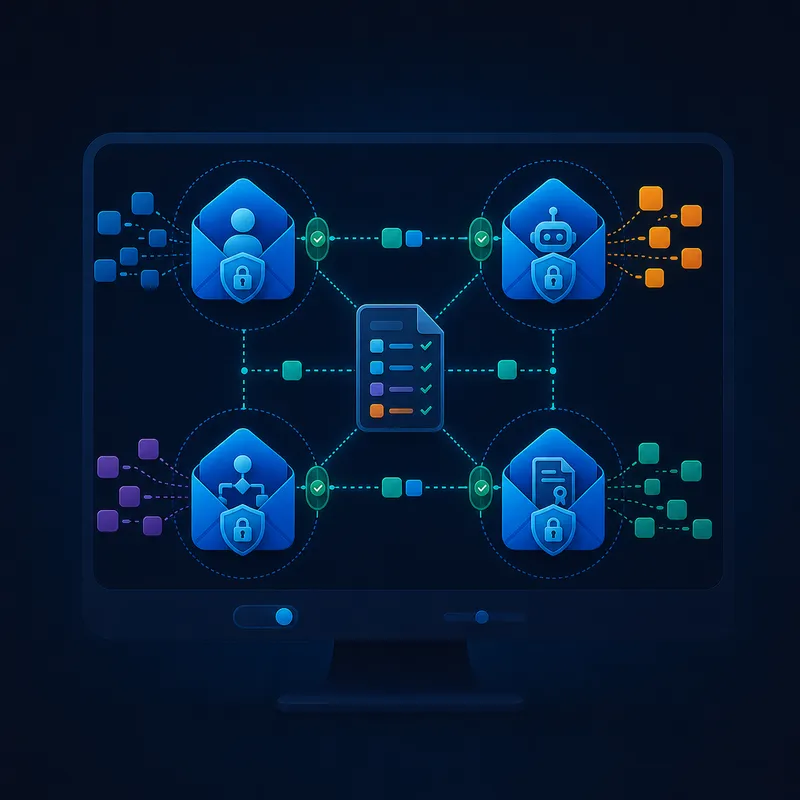
Inbox boundaries
Each Inbox owns one operating context with its own paths, schemas, identities, references, retention, display, and policy.
Control stays close to the business operation.
One message model
The original event is not overwritten by the logic that follows. DataInbox preserves what arrived, creates governed derived state, and treats every result as the next business message.
An API call, event, email, document, form, conversation, or agent result arrives as a business message.
The original message remains available before mappings, rules, enrichment, or AI create derived records.
The receiving Inbox resolves schema, identity, purpose, policy, routing, permissions, and required approvals.
People, systems, agents, or Companions perform only the work permitted for that message and context.
The decision, action, result, and next state return as traceable messages for the next explicit rule.
The operating stack
DataInbox separates what your organisation means and permits from the providers that perform the work. That distinction is what makes the architecture durable.
Each Inbox owns one operating context with its own paths, schemas, identities, references, retention, display, and policy.
Control stays close to the business operation.
Mappings, rules, routes, approvals, and result contracts decide what may happen before replaceable intelligence is invoked.
AI cannot silently redefine business authority.
Agents receive bounded context, approved tools, iteration limits, and a defined result contract inside the runtime loop.
Agent work becomes an accountable operation.
Connectors transport requests and results. Companions make approved AI, Payment, Identity, and future Voice or Delivery providers available to authorised Inboxes. They perform permitted operations and return state plus evidence through governed contracts.
Providers can change without owning authority or process state.

Policy before intelligence
The Inbox decides which message fields, references, tools, Companions, models, actions, approvals, and output requirements belong to the task. AI can interpret or propose. Deterministic configuration retains authority.
Federated by design
A Customer Inbox, Order Inbox, Finance Inbox, Legal Inbox, or personal strategy Inbox can each retain its own policy and source context. They exchange only permitted business messages, references, and outcomes.
That limits unnecessary exposure, keeps ownership clear, and lets one operation change without forcing every other department into the same data model.
Permitted dossier
References and governed outcomes for this specific decision, not unrestricted copies of every source.
Avoid architectural lock-in
Models, vendors, databases, and tools will change. DataInbox keeps their capabilities behind the Inbox contract so the organisation can choose again without rebuilding its business meaning from scratch.
Select by task, sensitivity, region, output, capacity, or cost.
Connect APIs, MCP services, people, and specialist providers.
Choose location, provider, direct access, recovery, and migration path.
Use the managed runtime or agree another regional or controlled arrangement.
Configuration is part of the architecture
The Inbox configuration is readable, versionable, and reviewable. Technical teams can use the DataInbox CLI to validate, compare, dry-run, and apply a proposed operating model without placing policy inside an opaque automation screen.
See how rules workDefine messages, paths, references, functions, policies, agents, and permitted capabilities.
Check authored configuration against the server-authoritative specification.
Review the exact difference from the live operating model before changing behaviour.
Inspect the intended request and validation result without mutating the live Inbox.
Activate the reviewed version and keep configuration and runtime outcomes traceable.
paths:
  orders:
    received: null
    review: null

rules:
  - id: route_approved_order
    event: { type: Data }
    condition:
      operator: equal
      field: status
      value: approved
    action:
      - move_to: /orders/review
Start with one operating problem
In one working session we can identify the first Inbox, its message contract, policies, required context, approved capabilities, and a practical path to a running use case.