
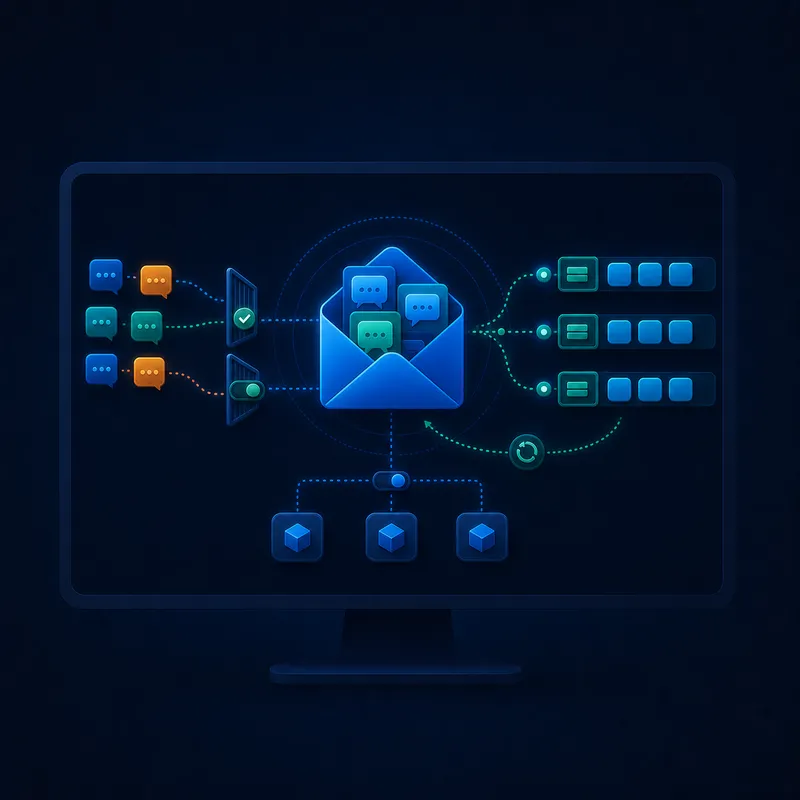
Choose the location
Select the region, data centre or customer-controlled environment that fits your legal, operational and contractual requirements.
Digital sovereignty is not a location checkbox. It means choosing the location, provider and operating model, retaining access and recovery options, and deciding how data represents your business. DataInbox governs the messages and decisions without forcing your operation into a SaaS vendor's data model.
The real sovereignty question
A database should reflect how your organisation works. Yet many SaaS products dictate the records, fields, workflows and access model because that is how their product was built.
DataInbox starts with business messages and your operating conditions. It connects what arrived to the customer, order, case, policy or decision it belongs to, then lets your rules determine what may happen next.
The infrastructure stores the data. Your organisation keeps the meaning and authority.
Control that remains practical
Once the deployment is agreed, DataInbox handles the controlled intake, context, rules and execution of business messages. You do not need to rebuild that operating logic around every storage provider.
Select the region, data centre or customer-controlled environment that fits your legal, operational and contractual requirements.
Use an agreed managed runtime, selected infrastructure provider or customer-controlled deployment without handing the provider ownership of your business model.
Your data remains accessible through the interfaces and security boundaries agreed for your architecture. DataInbox does not make the information captive to a hidden SaaS data model.
Restore the complete retained dataset when needed, subject to the backup, retention and recovery arrangements configured for your deployment.
From message to business operation
DataInbox does not make database technology the centre of the story. It turns complex incoming messages into governed business context that fits your process.
Orders, customer interactions, documents, payments, signals and system events enter through controlled connections.
The received message remains available as evidence before mapping, enrichment or rules change its operational meaning.
Schemas, identity, consent, permissions, policies and deterministic rules decide how the message may be used.
DataInbox connects the message to the customer, order, case, policy or process your organisation actually works with.
People, systems and agents receive only the context and capabilities allowed for that operating situation.
Freedom above infrastructure
Infrastructure will change. The meaning of an order, customer, approval or decision should not have to change with it.
Represent customers, orders, cases, approvals and decisions in the way your operation requires, instead of inheriting the limitations of a SaaS application.
Move a provider, database or runtime while keeping the governed message contracts, rules and consuming applications more stable.
Separate Inboxes can retain only the context they need and exchange approved messages or references. Sovereignty does not require one central database containing everything.
Keep the received source, changes, policy decisions, routes and outcomes connected so that restoration, replay and audit have business meaning.
Two valid starting points
Start directly
Begin with one valuable operating context without first designing a separate database project. DataInbox receives, retains, structures and governs the messages needed for that Inbox.
Connect what exists
Keep existing databases and systems of record. DataInbox adds a controlled business-message layer so applications and agents do not need unrestricted access to vendor-specific schemas.
Choose one operating context. Define its location, access, recovery and business rules. Then let DataInbox keep its messages governed across the architecture you control.