
Data and knowledge
Decide what an Inbox receives, where records remain, how long they are retained and which purpose allows their use.
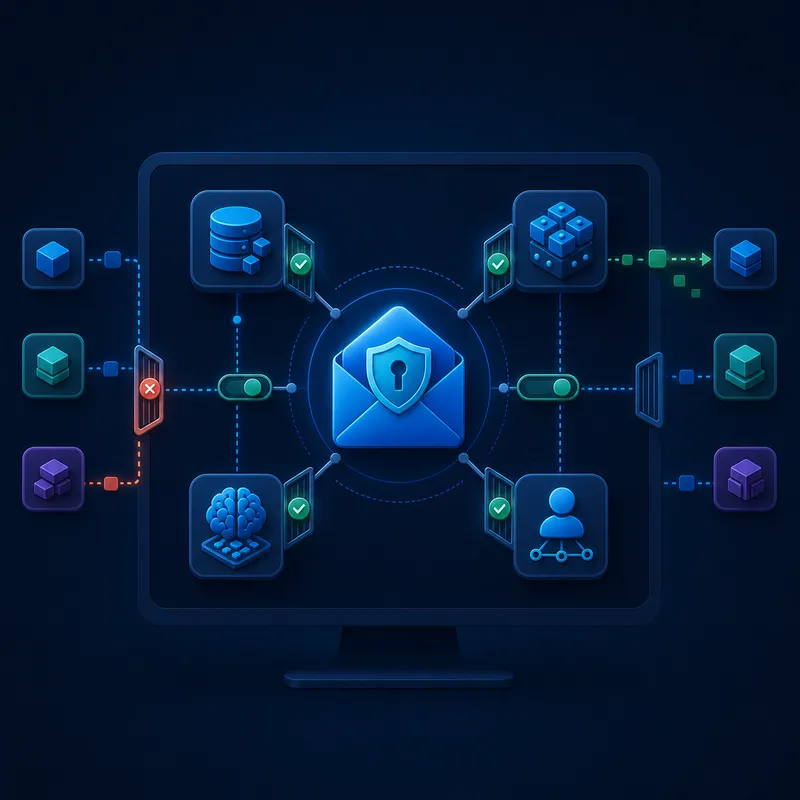
Digital sovereignty is not isolation. It is the ability to decide where data and the runtime live, which AI or external capability may be used, what context may cross a boundary and how every result returns to your governance.
Control, without isolation
The provider that stores data, runs infrastructure or performs inference does not need to own your business rules. DataInbox keeps those rules close to the operating context.
Each request can be evaluated before context leaves an Inbox. Each result can be evaluated again before it changes business state or reaches a person.
Technology may change. Your business contract remains stable and enforceable.
Six layers of control
A deployment location matters, but it is only one part of control. Data, identity, capabilities, movement and evidence need explicit conditions too.
Decide what an Inbox receives, where records remain, how long they are retained and which purpose allows their use.
Choose an agreed managed, regional or customer-controlled architecture that fits the operating and contractual context.
Select which model, provider, private endpoint or Companion may perform a task and which minimum context it may receive.
Keep access, purpose, approval and action rights with the business instead of embedding them in an AI provider.
Let separate Inboxes exchange only permitted messages, references and results without centralising every source record.
Retain the origin, policy decision, capability, approval, outcome and configuration change needed for accountability.
Provider-independent by design
An AI Companion can call one provider or route across several. DataInbox can also choose between approved Companions for cost, output quality, sensitivity, geography or another company-defined condition.
Schemas, purposes, permissions, approvals and result conditions remain part of the Inbox configuration.
AI, storage, routing and external services can change when the approved architecture changes.
A capability receives the task and permitted fields it needs, not automatic access to the complete business environment.
The output becomes a business message that can be validated, approved, rejected or used by deterministic rules.
Deployment is an architecture choice
Avoid vague promises such as “host anywhere”. Location, control and accountability only become real when the operating model is agreed and supported.
Managed SaaS
The current managed SaaS runtime configuration is hosted on DigitalOcean. Region, service boundaries and responsibilities are part of the agreed service architecture.
Selected architecture
Other arrangements can be designed around selected regions or data centres when they are part of the agreed technical and operational scope.
Customer control
Customer-controlled deployment can be considered where the product architecture, operations, support, security and service model are explicitly agreed.
Define the boundaries for one real operating context, then connect only the data and capabilities required to make it work.